BEST BUY • 2025
OVERVIEW
This project is a slice of a broader initiative to reduce avoidable customer contacts by making policy and “how-to” help topics easier to find and act on.
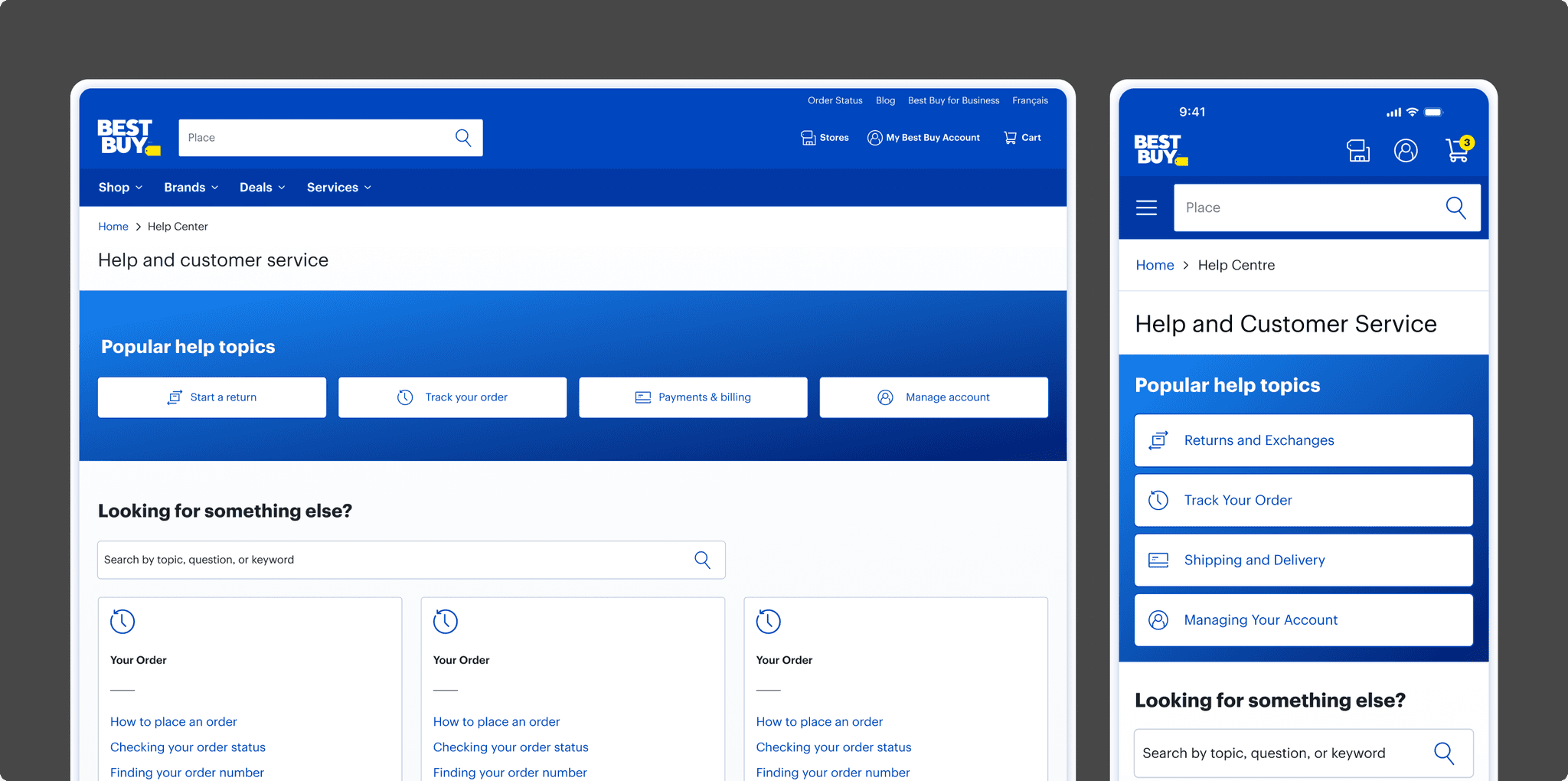
This case study focuses on the Help Centre experience (home, category, article, and a new search flow) and on de-emphasizing high-cost escalation paths (phone) in favour of self-serve and chat.
SKILLS
DISCOVERY RESEARCH
ANALYTICS ANALYSIS
INFORMATION ARCHITECTURE
INTERACTION DESIGN
ROLE
PRODUCT DESIGNER
TIMELINE
Q2 2025
PROBLEM SPACE
The existing Help Centre under-served self-serve customers and over-exposed phone/chat:
Strong “Contact Us” promotion
Prominent chat/call CTAs appeared on most help pages, priming escalation.
No search on the Help Centre
Users needed to scan dense category lists.
Cost mix
Phone is significantly more expensive than chat; both are more costly than self-serve.
Goals were to reduce avoidable contacts; shift mix away from phone.
Research & Discovery
I analyzed Help Centre traffic using Adobe to understand how customers arrived and where they dropped off. Additionally I met with our customer care lead to understand the most common topics they were getting calls on.
Afterwards, I benchmarked against competitors like Amazon and Walmart to ideate areas we could iterate on.
Key findings
SEO is a primary entry path. A large share of visits land on article pages and “Contact Us” from Google (returns, order status, shipping queries).
“Contact Us” was over-earning attention. Its placement and visual weight made escalation feel like the default next step.
Most visited pages top heavy on these topics. "Return/exchange policies for different product types" and "information about their order".
RESULTS
Business goal was to deflect avoidable contacts without hurting the experience; early signals suggest we’re bending cost while preserving a clear path to help.
~40% of home page visitors engage with Popular help topics
Call vs. chat mix shifted from ~70/30 to ~65/35 (phone down, chat up)
Estimated $300k+ annualized savings from channel-mix shift and reduced escalations
Bottom call/chat engagement down ~9% following the de-emphasis pattern; call clickthrough down ≥40%